
Order Within Randomness
 LOGOrder Within Randomness
There is so much in life we cannot know. Yet I don’t feel that everything happens without any rules at all. Looking back, I sometimes see reasons behind things I never expected. Events that seemed unrelated begin to feel like parts of a larger flow. It makes me wonder whether there are bigger rules I haven’t learned to see.
In my previous post, “A Life Already Written, a Future Unknown. In the End, Attitude.”, I wrote about how life might already be determined, but I still have to live it without knowing what comes next. This time, I want to take that thought a little further. If there are rules to the world we inhabit, what might we look like moving within them?
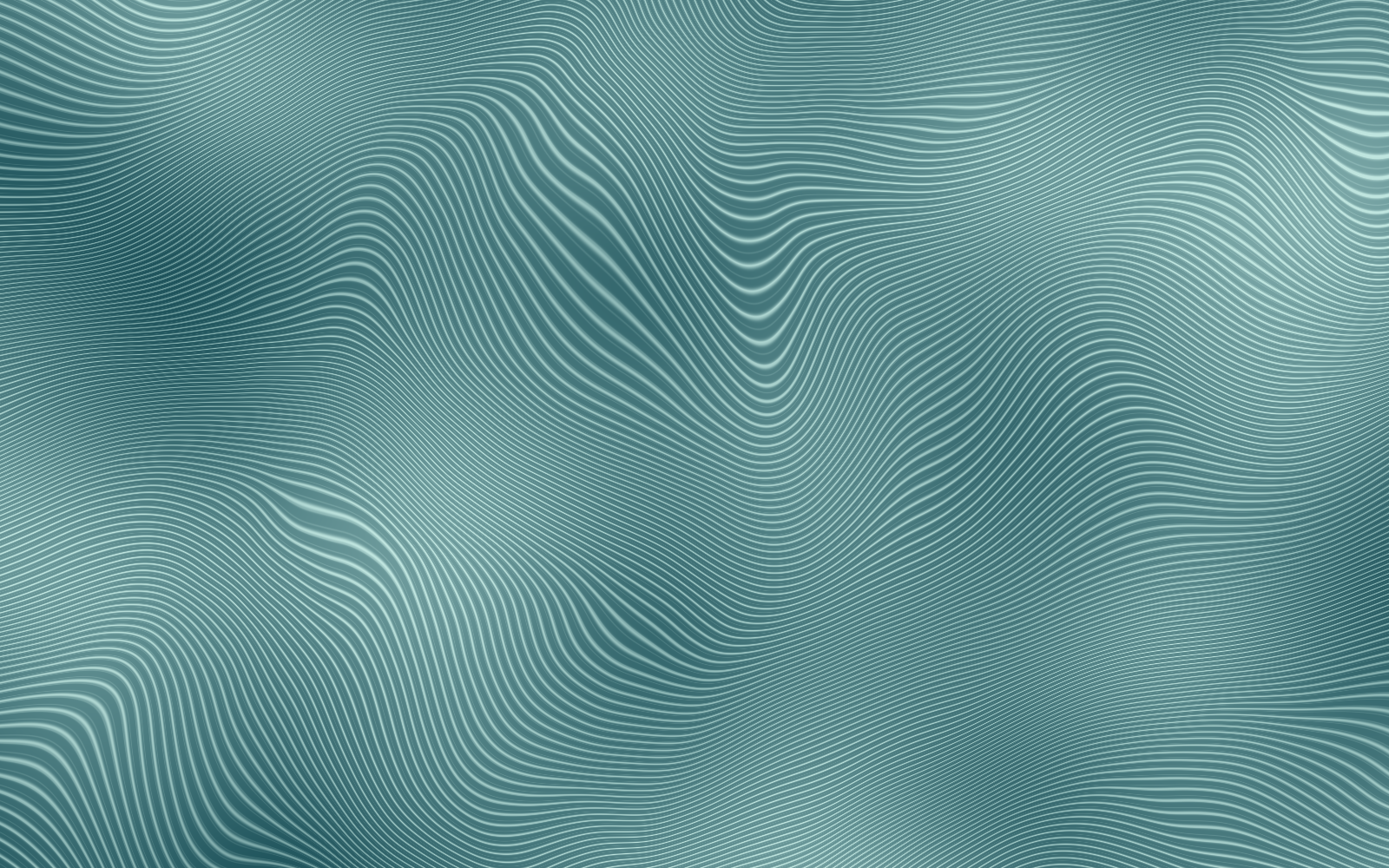
When I think about this, I think of Perlin noise.
When I see something like this, I find it hard to stop at the finished image. I want to look inside and understand how it was made. Eventually, I feel I need to build it myself to understand even a little. It’s a bit of a nerdy streak. Three years ago, that curiosity led me to study Perlin noise and implement it in code.
An image made with Perlin noise looks irregular at first. It is hard to guess where the light and dark areas will appear. Yet nearby values connect smoothly, and a sense of flow emerges across the image. Watching it, I feel there is some kind of order within what looks random.
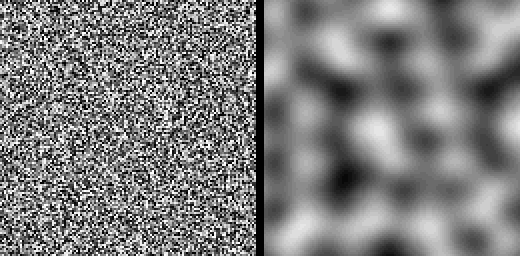
On the left, each pixel on a two-dimensional surface is assigned a random brightness. The values change independently, so looking at a neighboring pixel or the previous frame tells you little about what comes next. It feels like static on an old television: points flickering without any connection to one another.
On the right, it is still hard to tell at a glance what shape will appear next. But light areas lead into similarly light areas, and the transition into darkness is gradual. Over time, the blobs grow and shrink, while their internal light and dark patterns gradually reshape. Even as they change, the flow remains smoothly connected. I cannot predict the exact pattern, yet I sense some kind of order. I may not be able to explain what it is, but watching the movement leaves me with a feeling of connection.
From the side that makes the rules
What especially interests me is the difference between the person making this world and the person watching it. Three years ago, I studied the principles of Perlin noise and implemented them myself. I followed the code to understand how the values were calculated and how changing a variable changed the flow. In my implementation, the same coordinates produce the same value as long as the initial permutation table stays the same. A viewer may not understand the pattern, but there is a defined calculation behind it.
That brings me back to the thought in my previous post. Could events that feel accidental to us be taking place within rules we don’t know? Could there be a being that understands how the world works from a much wider perspective than ours? Perlin noise doesn’t prove that such a world exists. It simply feels like a way to turn a thought I’ve been carrying into movement I can see.
Following an invisible flow
Now let’s turn the brightness values into directions. One value can point right, another upward or left. This gives every position on the screen a direction. The image below shows those directions as arrows. A space like this is called a vector field.
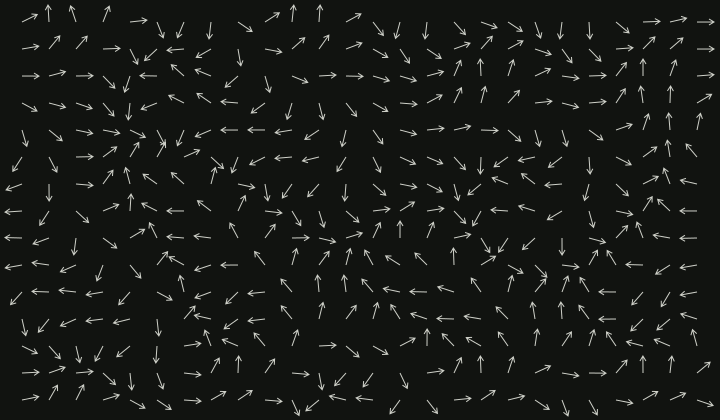
We can place particles in this space and have each one follow the arrow at its current position. What happens if we remove the arrows and leave only the paths the particles take?
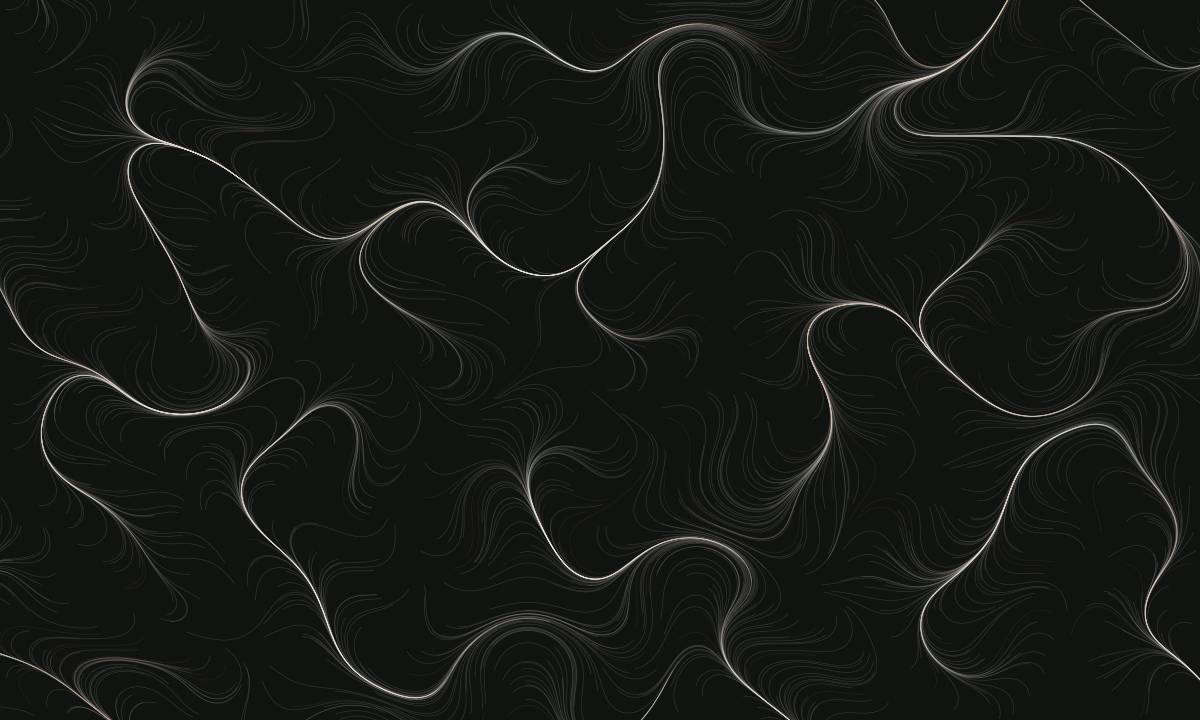
The particles seem to move separately, but across the whole image, a shared flow appears as they bend and gather. Even without the arrows, their traces let us sense the rules behind them. That is what draws me to this approach. Movement can convey a feeling of order without explaining every detail.
Moving differently within the same world
But the world I want to make contains more than particles following a flow. I want to place each of us inside it.
Being in the same flow doesn’t mean we all move in the same way. The same experience can shake one person deeply while another changes direction gradually. In the artwork, mass is one way I am considering expressing those differences.
Below, you can change the particles’ mass while keeping the force field the same. Under the same force, a particle with greater mass changes velocity more slowly. Change the mass and start again from the same positions: even within the same world, different paths emerge.
I also want to explore how people act on one another. Meeting someone can change the direction of a life. An encounter that feels small to me may stay with someone else for a long time. While the world moves us, we are also changing one another’s worlds.
In an earlier piece, particles left marks when they encountered a name written on the screen, or changed color and direction. This time, I want to develop a space where several presences influence one another’s movements. I want the changed paths to continue even after the encounter ends.
Order within randomness
At first, I was fascinated by finding a flow in seemingly random movement. But as I wrote the rules and moved particles within them, my attention shifted toward the beings inside that world.
We live without fully understanding the flow. We are affected by it, meet someone, change direction, and leave traces. Perhaps the attitude I wrote about in the previous post is part of that movement too. However the world may be determined, I am still someone living within it and encountering others.
I want to develop this idea into an artwork called Order Within Randomness, and eventually an exhibition. I want to make a world where movements beginning within one flow meet and change one another, and where their traces let us feel, later, that we were there.
The examples in this post are my first experiments toward that world.